Tuesday, September 10, 2019


















Tuesday, August 9, 2016
NJournal - Playing with 16 net Nemes
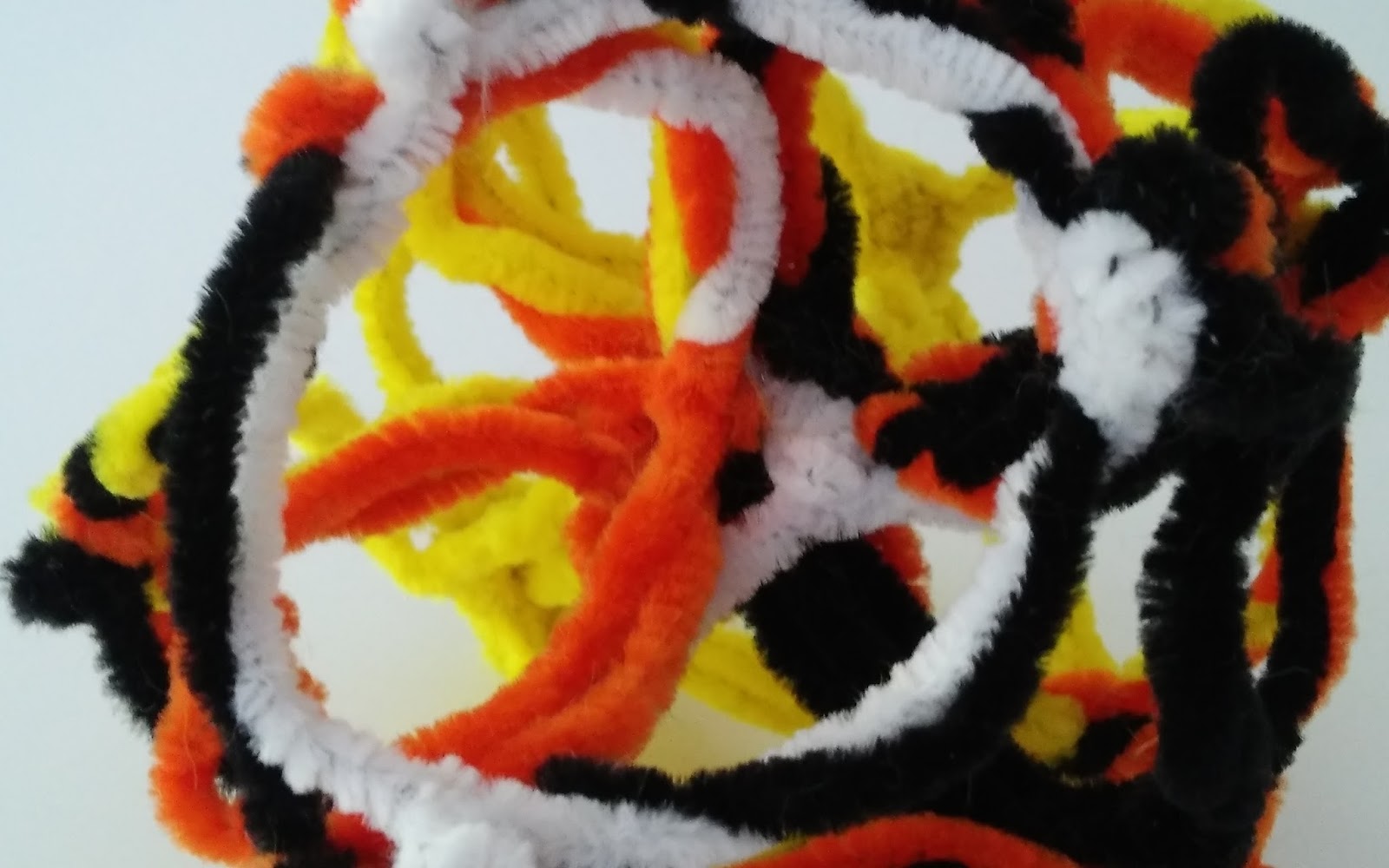
@toughLoveforx @antisignal @NewsNeus @ddrrnt @rotanarotana @PredictSwan How about this by using pipe cleaners http://bit.ly/2axbYiU
/Issue_0_1/stafford_beers_syntegration_as/images/fig1.gif)


Monday, May 9, 2016
NJournal notes 22.0 Course Outline for Mastering Complexity
How do you see the world?Choose A, B, C, D, or E.A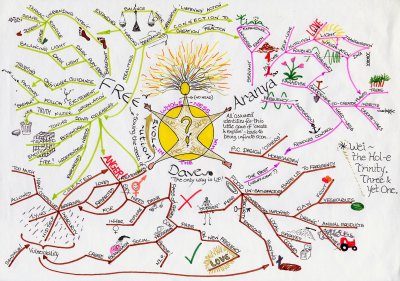 |
| Permission is granted to copy, distribute and/or modify this document under the terms of the GNU Free Documentation License, Version 1.2 or any later version published by the Free Software Foundation; with no Invariant Sections, no Front-Cover Texts, and no Back-Cover Texts. A copy of the license is included in the section entitled GNU Free Documentation License.from https://commons.wikimedia.org/wiki/File:Guru_Mindmap.jpg |
B
C

D

E
Please read the Winning Anywhere - The Power of 'See': The N-E-M-E Way February 21, 2014 by
If you think it would be helpful to have a conversation during your fast read, your instructors are ready and would be grateful for any conversation. You can be engage us on twitter, facebook or G+.
Thursday, March 17, 2016
NJournal Notes 22: Boundaries and Whorls
 |
| Figure 1 One frequency |
 |
| Figure 2 Two close frequencies |
 |
| Add Figure 3: Addition of boundary |
 |
| Figure 4. |
Wednesday, March 16, 2016
Njournal Notes 21. Boundaries
 |
| Figure 1 Time 1 |
 |
| Figure 2 Time + x |
 |
| Figure 3 Add boundary Time 1 |
 |
| Figure 4 Add boundary Ti + x |
Monday, March 7, 2016
NJournal Notes 20. Visualizing Macro Meso Micro
The image below was created using Ripple Tank Simulator. On the right hand side are the controls available.

Let's call area A the Macro level, area B the Meso level and area C the Micro level. The specific word or symbol is not important. What is important for nemetics is to understand any phenomenon it must be placed at the B | Meso level. The forces in play come from the proximate nShapes one level up and one level down.
Notice in the image there are no oscillators at the B level. The flow of forces are the result of interference patterns from A and C.
Let's call the overall rectangular boundary of Neme. In a context specific analysis the Neme would have more layers of A,B,C | Macro - Meso - Micro areas. The number of layers necessary depends on the number of dimensions that give a satisfactory answer to the question we are asking of the defined networks of complex adaptive system.
A context specific use of the tool requires more functionality. The vision is that with appropriate modifications we will be able to use a version of the software to visualize big data in a useful way for decision support.
Figure 2 below is a side view of the 3 D version of the overall field. It suggests we will be able to get a wave form for the Neme itself.
 |
| Figure 2 |
Friday, March 4, 2016
NJournal Ripple Tank Experiments RTE 3.03
At the boundaries of each shape are communication oscillators. As they oscillate, they create waves of affect, cognition, in the context of material conditions. The boundaries create constraints. The internal neme exchanges create complexity. The nemes sent out from the triad of nested shapes are waves that connect to nemes in the environment.
It can be pictured as below:
It can be pictured as below:
 |
| Figure 1 2D |
 |
| Figure 2. 2D |
 |
| Figure 3. 2D |
 |
| Figure 4.0 3D |
 |
| Figure 5.0 3D |
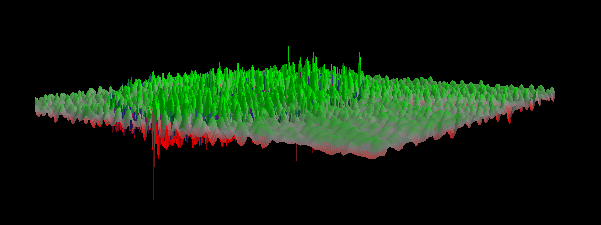 |
| Figure 6.0 - 3D |
Sunday, February 14, 2016
Njournal Notes 18. Mulling Emotion Waves or Affective Waves?
Excerpts from the article below:
"emotions arise from cognitive interpretations of core physiological experiences . . .
circumplex model of affect suggest that all affective states arise from two independent neurophysiological systems, which, for the purposes of discussion here, we term the valence and arousal systems . . . .
As emotions are experienced and communicated, cognitive interpretations are employed to identify the neurophysiological changes in the valence and arousal systems and conceptually organize these physiological changes in relation to the eliciting stimuli, memories of prior experiences, behavioral responses, and semantic knowledge
The circumplex model of affect: An integrative approach to affective neuroscience, cognitive development, and psychopathology
Jonathan Posner,a,b James A. Russell,c and Bradley S. Petersona,b
The circumplex model of affect proposes that all affective states arise from cognitive interpretations of core neural sensations that are the product of two independent neurophysiological systems. This model stands in contrast to theories of basic emotions, which posit that a discrete and independent neural system subserves every emotion.
We propose that basic emotion theories no longer explain adequately the vast number of empirical observations from studies in affective neuroscience, and we suggest that a conceptual shift is needed in the empirical approaches taken to the study of emotion and affective psychopathologies. The circumplex model of affect is more consistent with many recent findings from behavioral, cognitive neuroscience, neuroimaging, and developmental studies of affect. Moreover, the model offers new theoretical and empirical approaches to studying the development of affective disorders as well as the genetic and cognitive underpinnings of affective processing within the central nervous system.
Basic emotion theorists have primarily explored the behavioral and expressive manifestations of emotion. Investigations of the subjective, or experiential, components of emotion, rather than supporting a one to one correspondence between a discrete emotion and an underlying neural system, have instead suggested that emotions arise from cognitive interpretations of core physiological experiences (Cacioppo et al., 2000; Russell, 2003).

Mulling
The reality is that "emotion" are the conscious interpretations of physical states within the body. The physical state within the body are interactions between the material conditions outside the body, cognitive interpretations and affect created by the actions of two neural systems in the body.
So Emotion = affWave + cogWave + mWaves. According to the paper, emotions are on various spectrums. Bored to calm, depressed to serene, sad to contented, upset to happy, stressed to elated, nervous to excited.
Subscribe to:
Posts (Atom)